Saturday, 19 September 2015

Bryan Adams 'Summer of 69' video and lyrics
I got my first real six-string
Bought it at the five-and-dime
Played it till my fingers bled
Was the summer of '69
Me and some guys from school
Had a band and we tried real hard
Jimmy quit, Jody got married
I shoulda known we'd never get far
Oh when I look back now
That summer seemed to last forever
And if I had the choice
Yeah I'd always wanna be there
Those were the best days of my life
Ain't no use in complainin'
When you got a job to do
Spent my evenings down at the drive-in
And that's when I met you, yeah
Standin' on your mama's porch
You told me that you'd wait forever
Oh and when you held my hand
I knew that it was now or never
Those were the best days of my life
oh yeah
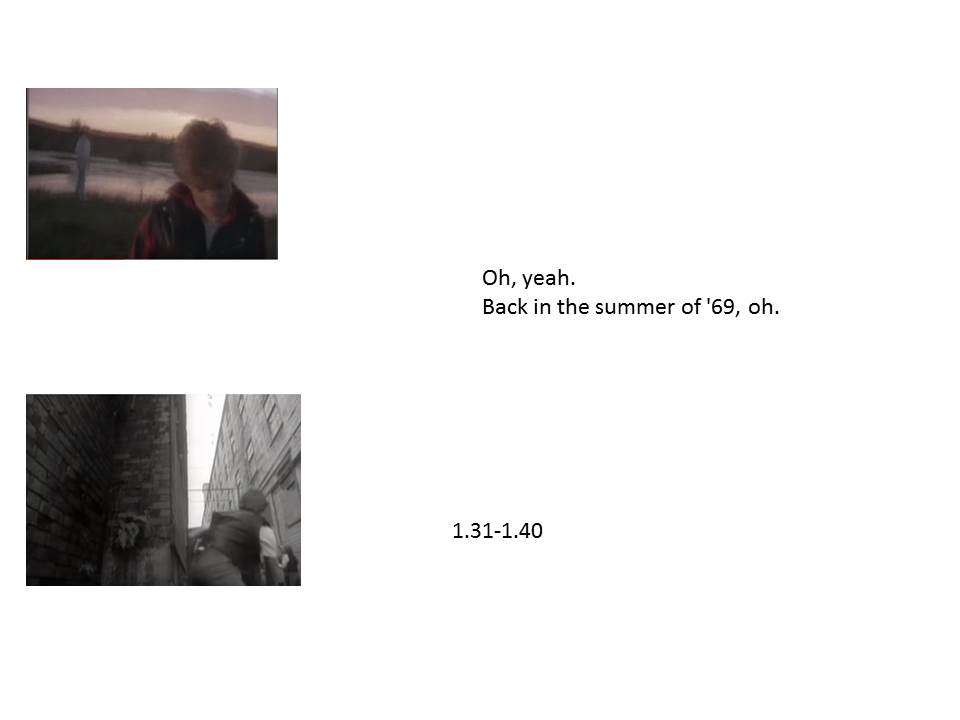
Back in the summer of '69
Man we were killin' time
We were young and restless
We needed to unwind
I guess nothin' can last forever - forever, no yeah
And now the times are changin'
Look at everything that's come and gone
Sometimes when I play that old six-string
Think about you wonder what went wrong
Standin' on your mama's porch
You told me that it'd last forever
Oh and when you held my hand
I knew that it was now or never
Those were the best days of my life
Oh yeeaahhhhh Back in the summer of '69
uhh huh, it was the summer of '69
ohh yeahh me and my baby in '69
ohhhhhhhh
it was the summer, the summer, the summer of '69
YEAH
Me and some guys from school
Had a band and we tried real hard
Jimmy quit, Jody got married
I shoulda known we'd never get far
Oh when I look back now
That summer seemed to last forever
And if I had the choice
Yeah I'd always wanna be there
Those were the best days of my life
Ain't no use in complainin'
When you got a job to do
Spent my evenings down at the drive-in
And that's when I met you, yeah
Standin' on your mama's porch
You told me that you'd wait forever
Oh and when you held my hand
I knew that it was now or never
Those were the best days of my life
oh yeah
Back in the summer of '69
Man we were killin' time
We were young and restless
We needed to unwind
I guess nothin' can last forever - forever, no yeah
And now the times are changin'
Look at everything that's come and gone
Sometimes when I play that old six-string
Think about you wonder what went wrong
Standin' on your mama's porch
You told me that it'd last forever
Oh and when you held my hand
I knew that it was now or never
Those were the best days of my life
Oh yeeaahhhhh Back in the summer of '69
uhh huh, it was the summer of '69
ohh yeahh me and my baby in '69
ohhhhhhhh
it was the summer, the summer, the summer of '69
YEAH
Watching this tutorial was really helpful when I was filming my first draft. Although I'm not using Lego, I wanted to see what the technique was to making it look like they were moving. I also got to see the camera position and how much I needed to move the characters to make the movement look fluent.
I watched these videos to get an idea about how people did their stop frames to make them look good. I wanted to see what kind of things people made the characters do to make it fit with the video. I also wanted to see how many other props they used.




John Fiske (1982) (media language)
As John Fiske (1982) puts it “denotation is what is
photographed, connotation is how it is photographed”. Link to Barthes’ editing at stage of production.
Related to connotation is what Roland Barthes (1977) refers to as myth. For Barthes myths were the
dominant ideologies of our time. The 1st and 2nd orders of signification called denotation and connotation combine to
produce ideology - which has been described as a third order of signification by Fiske
and Hartley (1982).

Charles Sanders Peirce (1931) (Media Language)
“we think only in signs”
•Signs take the form of words, images, sounds, odours, flavours, acts or
objects, but such things have no intrinsic meaning and become signs only when we invest
them with meaning.
•“Nothing is a sign unless it is
interpreted as a sign” (Peirce,
1931).
•Anything can be a sign as long as someone interprets it as 'signifying'
something - referring to or standing
for something other than itself. We
interpret things as signs largely unconsciously by relating them to familiar
systems of conventions. It is this meaningful use of signs which is at the
heart of the concerns of semiotics.

Three
types of sign...
Icon/iconic: a mode in which the signifier is perceived as resembling or imitating the signified (recognizably looking, sounding, feeling,
tasting or smelling like it) - being similar in possessing some of its
qualities: e.g. a portrait, a cartoon, a scale-model, onomatopoeia, metaphors,
'realistic' sounds in 'programme music', sound effects in radio drama, a dubbed
film soundtrack, imitative gestures
Index/indexical: a mode in which the signifier is not
arbitrary but is directly connected in some way (physically or causally) to the signified - this link can
be observed or inferred: e.g. 'natural
signs' (smoke, thunder, footprints,
echoes, non-synthetic odours and flavours), medical
symptoms (pain, a rash, pulse-rate), measuring instruments (weathercock, thermometer, clock, spirit-level).
Symbol/symbolic: a mode in which the signifier does not resemble the signified but which is fundamentally arbitrary or purely conventional - so that the relationship must be learnt: e.g. language in general (plus specific languages, alphabetical letters, punctuation marks, words, phrases and sentences), numbers, morse code, traffic lights, national flags.
Subscribe to:
Posts (Atom)